
Plantation Directory Collections to Check
No official catalog inspected provides an exact publisher-by-year run for Plantation. That gap must remain visible. The verified collection paths range from statewide city-directory holdings to regional databases and local reference collections. Ask for Fort Lauderdale and Broward titles as well as Plantation because the city formed after metro publishing patterns were established.
| Collection | Years represented | Where held | Access |
|---|---|---|---|
| Florida city directories | Early 1900s to present statewide; local years need confirmation | State Library Florida Collection | On-site, catalog, and reference request |
| U.S. city directories | Database collection dependent | Fold3 through Broward County Library | Library card or in-library database access |
| Fort Lauderdale/Broward regional titles | Exact years not published on inspected pages | State, Broward, and Hoffman library catalogs | Ask for title, year, publisher, reverse section |
| Historical newspapers | Title and license dependent | Broward Library and Florida resources | Card or in-library limits may apply |
| Federal census | 1790 through 1950 now public | NARA and library databases | Search name, address, and enumeration district |
| Plantation community collections | Incorporation era forward; item dates vary | Plantation Historical Museum | Reference inquiry or visit |
| Sanborn maps | No Plantation sheet set verified | Library of Congress and Florida catalogs | Search regional coverage without assuming a local run |
A missing catalog row does not prove that a directory never existed. It means the shelf list must be confirmed before citing a title or year. No Polk or R. L. Polk run should be claimed without that check.
Plantation Under Fort Lauderdale Titles
Plantation's timeline explains the catalog problem. Frederick Peters bought about 10,000 acres in 1931, and the first development took shape around East Acre Drive. Plantation incorporated in 1953, opened its library building in 1968, and expanded west through major growth and annexation from the 1970s into the 1990s. A city directory publisher could therefore treat an address as part of metropolitan Fort Lauderdale or Broward rather than issue a separate Plantation volume.
Search title catalogs with several place forms: Plantation, Fort Lauderdale, Broward County, the subdivision name, and rural-route language. A telephone book may also fill a year that has no alphabetical city directory. This geographic quirk is not a license to assign a regional entry to Plantation blindly. Match the address or subdivision against deeds, plats, maps, and later city records.
Florida's Plantation Directory Shelf
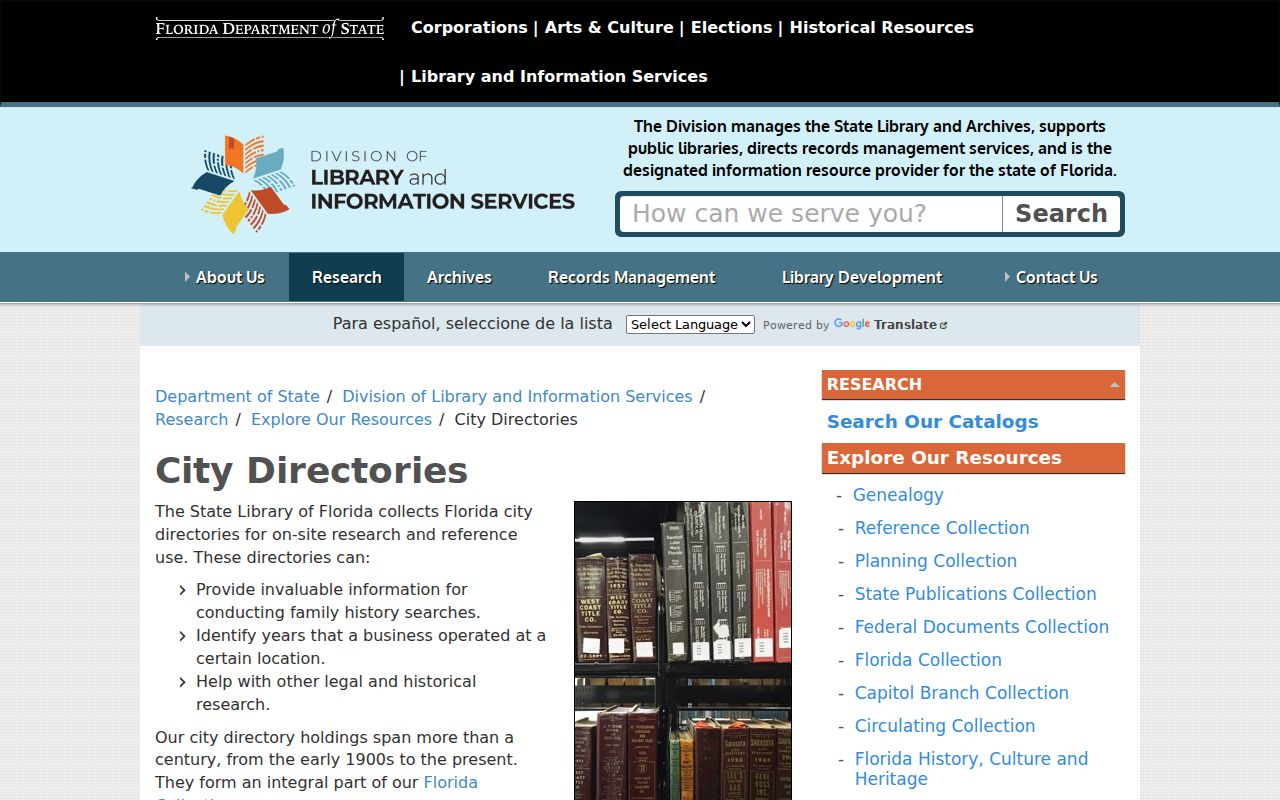
The State Library of Florida city-directory collection spans the early 1900s to the present across Florida. Volumes are arranged by city and year for on-site reference. Its page points researchers to the catalog and the Florida Memory research guide called “It's In the Directory.” The reference desk can help identify likely metro titles at 850-245-6682 or library@dos.myflorida.com.
The official State Library page appears in the captured image below.
Use the catalog result as a starting point, then request the title page, year, publisher, and whether the volume includes a street-order section.
Broward Genealogy Beyond City Directories
Broward County Library genealogy resources include Fold3 city-directory, naturalization, and military materials, along with the Florida Electronic Library and digitized historical Black newspapers. Database coverage varies, and access may require a Broward library card or an in-library session. Search both a person's name and the likely volume, then browse nearby pages because poor optical character recognition can hide a valid entry.
The Broward genealogy landing page is preserved in this successful manifest image.
Newspapers can test a directory clue through an obituary, social item, legal notice, subdivision advertisement, or address report, but every role and date still needs a source citation.
Read a Plantation Directory Entry
No digitized sample Plantation entry was verified in the official sources, so the fields below are an interpretation checklist, not a fabricated local record. Read the volume's own abbreviation key first. Publishers changed conventions, and the same letter can mean something different in another edition.
| Name | Surname, given name, and initials; a spouse may appear in parentheses. |
|---|---|
| Family status | “wid” commonly identifies a widow and may name the deceased spouse. |
| Occupation | Job title, trade, or employer as reported for that edition. |
| Address | Home, rooming, or work address according to the volume's symbols. |
| Telephone | A listed number, not proof that all household members appear. |
| Tenure mark | Some volumes identify an owner or renter, but only when the key says so. |
| Cross-reference | A pointer following a name change, alternate listing, or business entry. |
- Criss-cross directory
- A street-order section that lists house numbers, occupants, and often telephone numbers.
- Householder index
- An address-led list of the person identified as head or listed subscriber.
- Abbreviation key
- The publisher's legend explaining residence, occupation, family, and tenure symbols.
- Canvass date
- The period when information was gathered, which may precede the printed year.
Plantation's Local History Keepers
The Helen B. Hoffman Plantation Library is the first local inquiry point, but its public pages do not enumerate directory years. Ask directly about telephone books, vertical files, neighborhood histories, yearbooks, microfilm, and referrals to Broward Main Library's local-history staff. The Plantation Historical Museum is the other key local keeper for photographs, clippings, exhibits, and donor collections related to Peters, East Acre, incorporation, and annexation.
Neither institution's inspected page confirms a complete reverse-directory shelf. A precise inquiry saves time: request a title-level list with year, publisher, call number, format, access hours, copy rules, and whether staff can check one name or address. Community histories can explain why a person appears under a subdivision or regional label even when a Plantation city directory search fails.
Trace Plantation Families Across Editions
A run of directories can narrow a move or death to the years between two editions. Absence alone proves little. A person may be unlisted, recorded under initials, missed by the canvass, placed under a nearby postal city, or living in a part of west Plantation not yet inside the municipal boundary.
- Establish the modern parcel and legal description through BCPA before opening the oldest volume.
- Confirm the building or subdivision date so searches do not begin before the address existed.
- Browse each available reverse section by street and house number, preserving vacant or new-construction years.
- Switch to the alphabetical section for surname variants, initials, spouse references, and moves.
- Pair findings through 1950 with federal census households and enumeration geography.
- Bridge later gaps with deeds, telephone books, permits, obituaries, and newspapers.
- Record the last certain appearance and first certain absence without guessing what happened between them.
The census is released after 72 years, making 1950 the newest public population schedule in 2026. Directory dates can fall between census decades, but their printed year may lag the canvass. Keep the two source types distinct.
Plantation Clues in State Archives
The State Archives of Florida broadens the search beyond printed directories through photographs, maps, manuscripts, and government series. Search the catalog for Peters, Plantation, Broward subdivisions, municipal records, and regional road names. Florida Memory may provide digitized context even when the directory itself remains an on-site item.
The State Archives access page is shown in this manifest capture.
Archive descriptions identify collections, not necessarily individual residents. Use names, dates, and addresses found there as leads to a cited directory page, deed, census record, newspaper, or vital source.
Plantation Directory Geography Timeline
Plantation's city directory evidence fits a short local timeline. These dates explain shifts in labels and jurisdiction; they do not establish that any particular directory was published.
| Year or period | Local change | Directory consequence |
|---|---|---|
| 1931 | Peters acquired about 10,000 acres | Early references may use land, route, or subdivision language |
| Early development | East Acre Drive marked first construction | Plats and regional sources may predate a city listing |
| 1953 | Plantation incorporated | Standalone city naming becomes more plausible, not guaranteed |
| 1968 | Municipal library building opened | Local reference collections gained an institutional home |
| 1970s to 1990s | Growth and annexation moved west | City jurisdiction could change without a household move |
The authentic story is a planned, postwar suburb rather than an old county-seat directory tradition. Fort Lauderdale is the county seat, and metro titles may be more important than a missing standalone volume.