
Start a Plantation Residents Directory Search
Begin with the strongest known key. A street address points first to the Broward County Property Appraiser, while a person's name can be tested against the same roll, Broward Official Records, the court party index, voter resources, Sunbiz, and professional licenses. A permit or code number belongs in Plantation Accela. An older address may require recorded deed images, library databases, or museum files. Each source answers a narrow question, so a match becomes useful only after its name, date, parcel, or address agrees with another record.
The public trail has firm gaps. A tax roll identifies assessed owners, not every member of a household. Voter records omit nonvoters and exempt data. Renters, children, utility customers, protected residents, sealed cases, and confidential vital records do not form a public Plantation household roster. Use the following order as a research path, not as a claim that everyone at an address will appear.
- Search the Broward property roll by owner name, situs address, or folio and note the legal description.
- Use Florida's voter self-lookup for personal registration, or request lawful voter data from Broward Elections.
- Follow the owner or parcel into Official Records for deeds, mortgages, liens, and satisfactions.
- Check Plantation Accela for permits, inspections, business tax records, and code cases keyed to the address.
- For past households, ask libraries and archives about directories, newspapers, yearbooks, and historical indexes.
- When an identified record is not online, contact its custodian with the record type, number, and date range.
Where Plantation Resident Records Are Kept
Plantation is not the Broward County seat, so the main property, recording, court, and election trails sit at county offices rather than City Hall. The city keeps permits, planning files, code cases, local business tax records, agendas, and police reports. Broward maintains the property roll, deeds, liens, court and probate files, marriage records, voter data, and bookings. Florida agencies add vital certifications, professional licenses, corporations, corrections, and offender records. This split is why a search should begin by choosing the custodian for the precise record series.
Broward Recording Office
115 S Andrews Avenue, Room 114
Fort Lauderdale, FL 33301
954-831-4000
Broward Property Appraiser
115 S Andrews Avenue, Room 111
Fort Lauderdale, FL 33301
954-357-6830
Broward Elections Office
4650 NW 21st Avenue
Fort Lauderdale, FL 33309
954-357-7050
Plantation Property Names Begin With a Parcel
The Broward County Property Appraiser search is the fastest official bridge between a Plantation name and land. It accepts owner name, site address, property ID or folio, subdivision, and map approaches. A parcel card commonly shows owner and mailing names, site address, legal description, municipality, use, assessed values, exemptions, sales references, year built, and links to a sketch, photo, or map. Mailing and site addresses must remain separate: the first may lead to an absentee owner, trustee, or entity, while the second identifies the assessed land.
| BCPA search key | Best use | Reading caution |
|---|---|---|
| Owner name | Find parcels tied to a person or entity | Try variants and omit punctuation |
| Site address | Identify the assessed owner at one place | Normalize direction and suffix |
| Folio | Open one exact parcel record | May appear with or without hyphens |
| Subdivision or map | Handle changed streets or vacant lots | Map data are not survey-grade |
The assessment roll does not guarantee title, current occupancy, exact dimensions, or a complete household. Homestead exemption may support owner occupancy but does not identify everyone who lives there. Protected-person exemptions can suppress a name or address. Once a parcel is found, its sale instrument or book and page can lead into the deed index.
Broward's 1977 Search Divide Matters in Plantation
Broward Official Records has a precise digital boundary. Full name searching begins July 7, 1977. Records from March 9, 1972 through that date use instrument number, book type, Official Records book and page, or recorded date. Earlier material is absent from the web system even though county-held images extend to 1871. Online images are described chiefly as 1978 forward; older media require the Search and Copy service, a written request, or an office visit.
The portal offers direct and indirect party names, book and page, document type, instrument, case number, consideration, recorded date, simple guided searches, and parcel ID. Results may reveal party role, recording date, instrument, abbreviated legal description, and an image. Search all spelling forms and follow both sides of a deed. A status marked “U” means the entry has not been double-checked, not that the instrument failed to record.
Insider point. “Not found online” can mean a date lies outside the name index, not that Broward lacks the record.
Plantation Accela Turns Addresses Into City Files
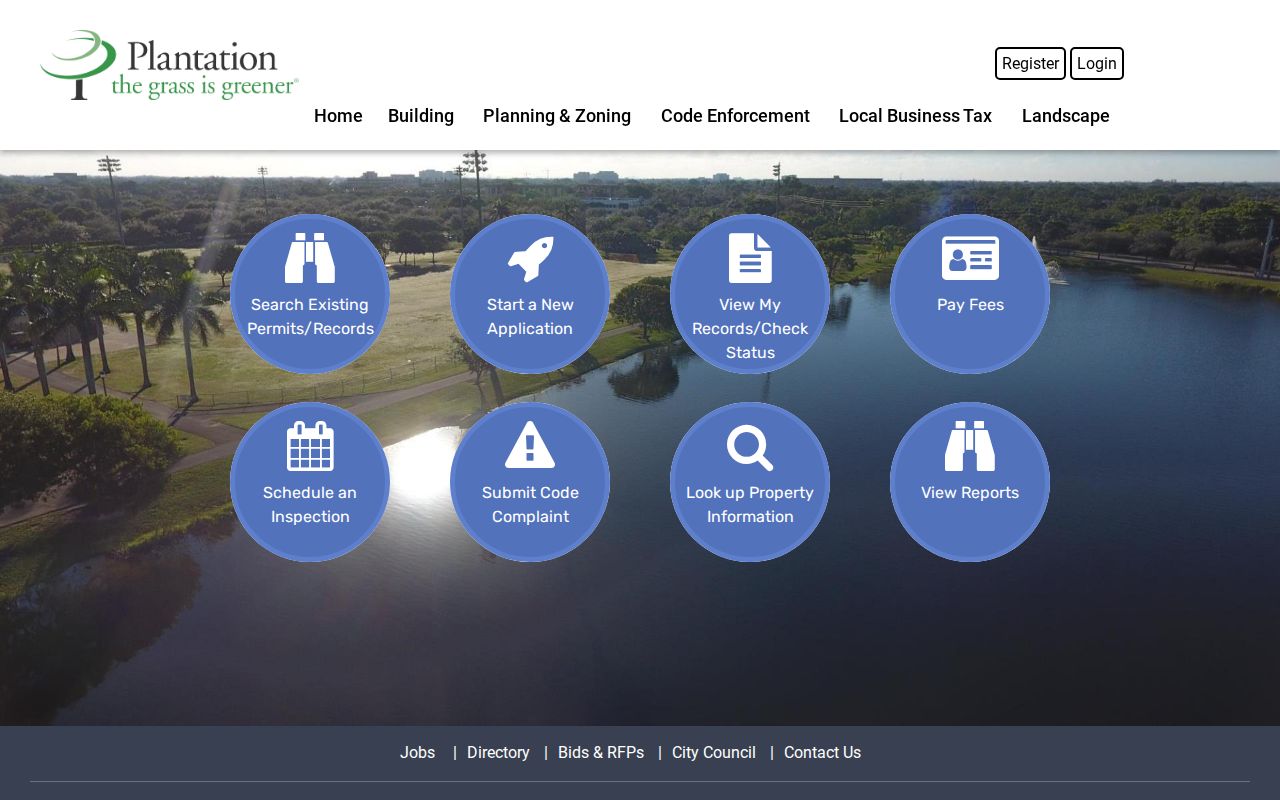
The city side begins with Plantation Accela Citizen Access. Its Building, Planning, Engineering and right-of-way, Business Tax, and Enforcement modules accept record number, street number and name, parcel number, record type, and date range. Guest users may view basic property facts, check record or inspection status, follow processing, and make payments. Registered access supports applications, renewals, complaints, and inspection scheduling.
Typical results include record type and number, project address, description, status, application date, public applicant or contractor information, inspections, status dates, fees, and released documents. Accela fills an address-centered gap when a tax roll says who owns land but not which permits, code activity, or local business record touches it. Search before requesting a file, then give the City Clerk the exact record number if online detail is incomplete.
The official Plantation permit and code portal shows the modules available for an address search.
Current Plantation Directory-Like Rolls
No current source lists all Plantation residents. Public offices maintain purpose-built rolls that overlap. The property roll covers assessed owners; the voter system covers registered voters under election-law rules; Official Records indexes parties to recorded instruments; court search covers named case parties; and Accela connects public names to city records. Choosing the roll that matches the question reduces false matches.
| Source | Who It Lists | Keeper | Access |
|---|---|---|---|
| BCPA assessment roll | Owners and parcel facts | Property Appraiser | Free search |
| Broward voter resources | Registered voters, subject to exemptions | Supervisor of Elections | Self-lookup or data request |
| Official Records | Parties to deeds, liens, judgments, and plats | Records, Taxes and Treasury | Free index; older-media request |
| Broward Case Search | Named parties in public dockets | Clerk of Courts | Free docket search; file fees may apply |
| Accela Citizen Access | Public applicants, contractors, permits, and code files | City of Plantation | Guest basic search |
Official rolls are strongest when their original purpose fits the question. Commercial people-finder output may merge old addresses and reused phone numbers from unclear sources, while an official index identifies its custodian and record type. Neither proves current residence alone. For a name-first process, use the Plantation resident lookup and require agreement across independent records.
Plantation Names in Broward Court and Probate Records
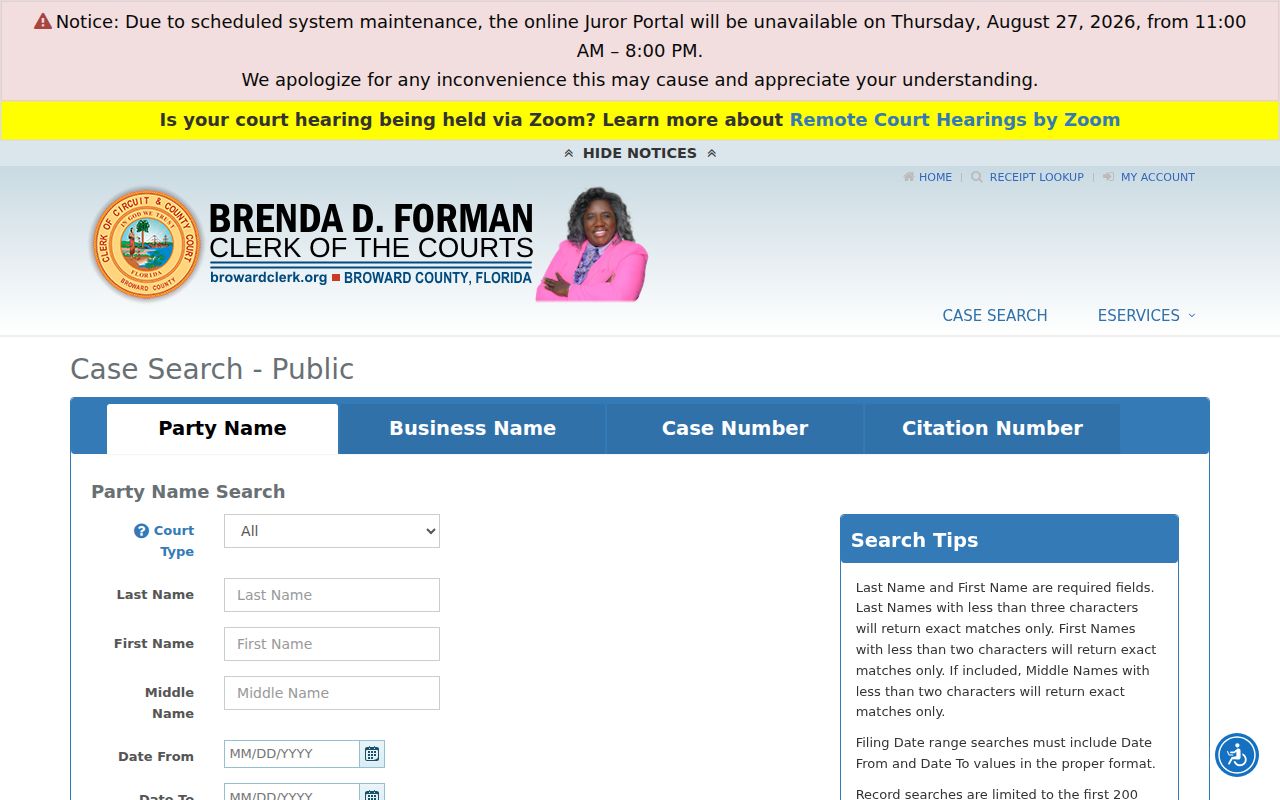
The Broward Clerk Public Case Search accepts party name, business name, case number, citation, date of birth where allowed, and court type. Results stop at 200, so common names need a middle name, date range, or division filter. A result may show case number, role, court type, filing date, status, judge, events, and a document register. It is an index and docket first; some images require purchase, registered access, a counter visit, or a written request.
Probate may connect a decedent, personal representative, publicly named heirs, and property, but every docket needs context. Family, guardianship, mental-health, probate, and domestic-violence material has tighter electronic access. Older or unavailable files go through Clerk Archives or the proper division. Stated request charges are $1 per page, $2 per certification, and $2 per case-year search; an electronic certified document costs $8.
The official Broward court search separates party, case, and citation routes.
Florida Voter Records Do Not Make a Plantation Roster
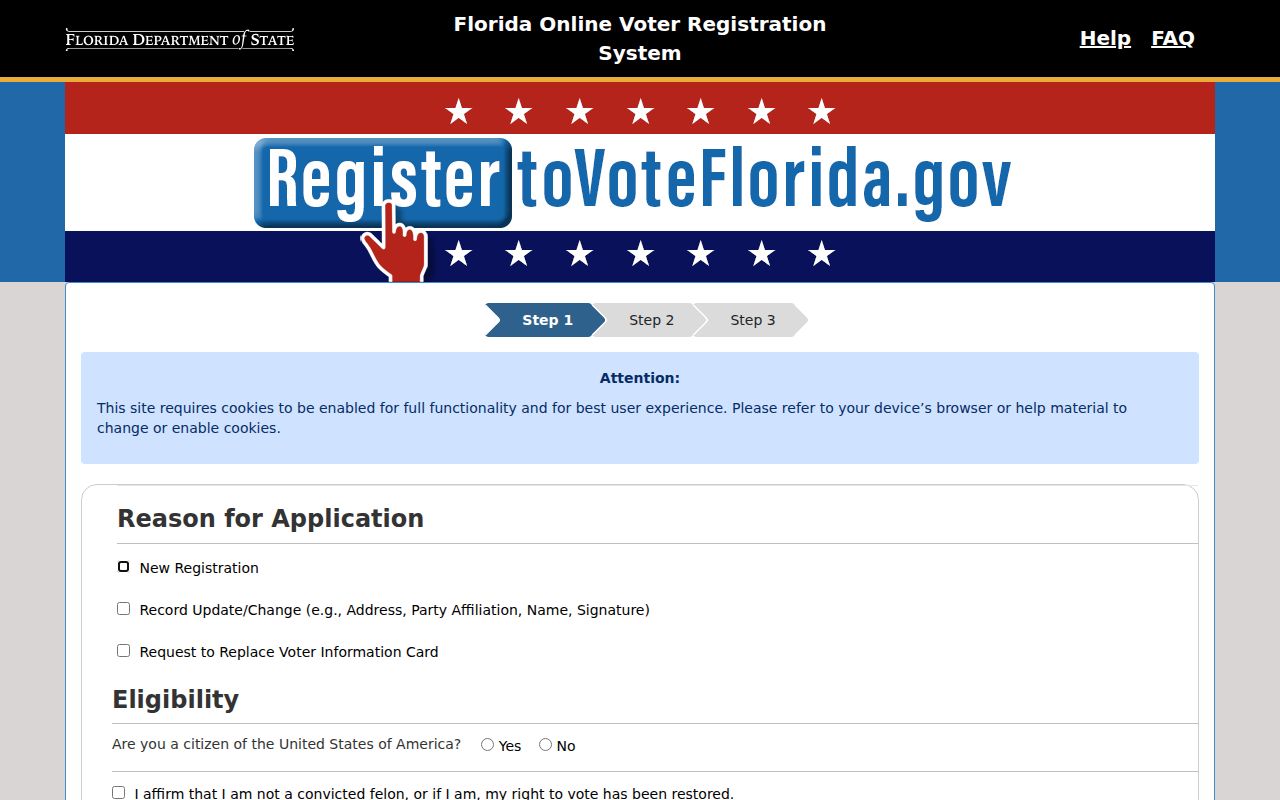
Florida's registration-status tool is designed for a voter to check personal status and polling information with identifying fields. It is not a browse-by-street public directory. Broward Elections separately accepts requests for electronic registered-voter records and inspection, subject to exemptions. Social Security, driver-license, and Florida identification numbers are not released, and address exemptions protect some people and families.
A county data request can support lawful civic or family research, but it cannot stand as a complete Plantation residents directory. Registration omits people who are not registered, and a record may lag a move. The researched Broward channel states a $20 search charge, with custom, media, or inspection costs possible. Ask for the format, date, fields, exemptions, and estimate before work starts.
Florida's official voter information lookup shows why self-lookup differs from a bulk records request.
Plantation Public Records Requests After a Portal Ends
Florida's constitutional access right appears in article I, section 24, and chapter 119 supplies inspection and copying rules. A requester ordinarily need not live in Florida, state a purpose, or use special words. A custodian must respond in good faith within a reasonable time, not one fixed statewide deadline. Requests work best when they name a record series, office, address or parcel, record number, and date range. Ask for electronic delivery and a cost estimate when staff research may be extensive.
For Plantation files, the City Clerk coordinates requests from City Hall at 400 NW 73rd Avenue, Plantation, FL 33317, telephone 954-797-2200. City records include agendas, contracts, local business tax files, permits, code matters, zoning applications, and releasable police reports. Email sent to the city is generally itself a public record, so phone or writing may be preferable when that fact matters.
Lawful personal use. Search records for genealogy, property history, reconnecting, estate work, consumer safety, or civic knowledge. Never use a result to stalk, harass, threaten, or harm anyone.
Historical Sources for Plantation Residents
Plantation was incorporated in 1953 and grew quickly after World War II, so its historical trail is often filed under greater Fort Lauderdale or Broward County rather than Plantation alone. The official catalogs inspected do not publish a verified year-by-year Plantation shelf run. A careful search asks staff to confirm title, year, geographic coverage, and format before claiming that a volume exists.
The State Library of Florida holds city directories arranged by city and year and offers catalog and reference help. Broward County Library routes cardholders to Fold3, historical newspapers, Florida Electronic Library resources, and genealogy tools. The Helen B. Hoffman Plantation Library, whose building opened in 1968, adds municipal help. Plantation Historical Museum is suited to photographs, clippings, yearbooks, telephone books, family collections, and neighborhood files. The complete shelf method belongs in the Plantation city directory guide.
A directory entry can place a named adult or business at an address for one publication year; it does not establish unbroken residence. Compare adjacent editions, census schedules, deeds, obituaries, and permit files. Search older subdivisions and legal descriptions because deeds or plats may predate a modern street address. This layered approach preserves what each source proves.